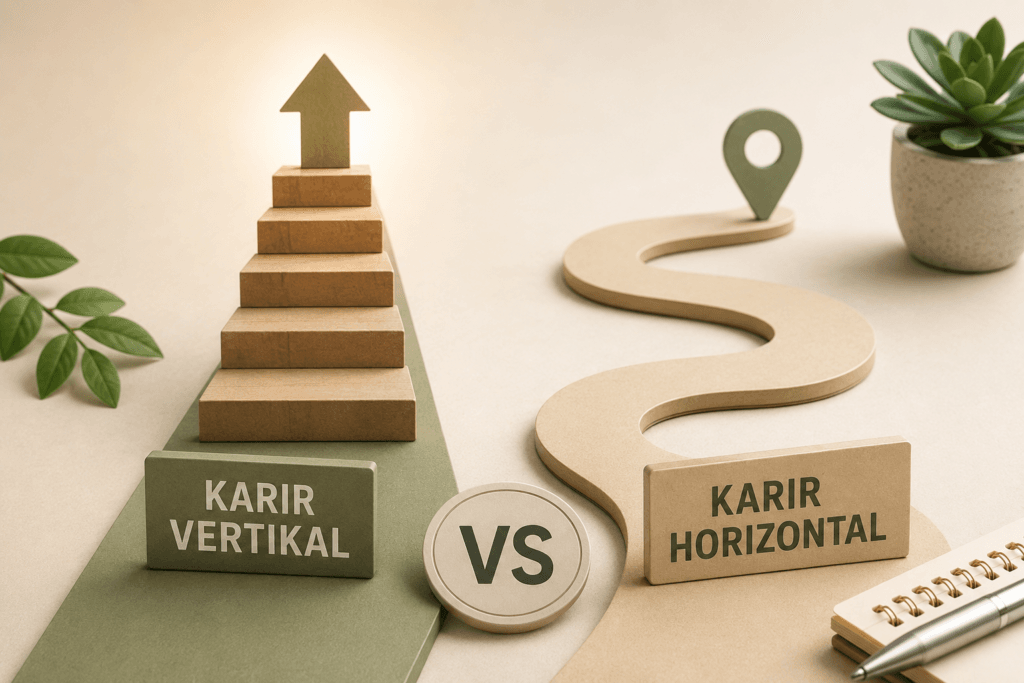
Vertical career and horizontal career are two different directions in your professional journey. One path moves you up in rank, the other path broadens your skills without an instant promotion.
Many managers struggle to choose between a vertical career and a horizontal career because both paths look equally promising. This article breaks down the differences, the global data, and how to find the path most relevant to your situation.
| Aspect | Vertical Career | Horizontal Career |
|---|---|---|
| Main focus | Moving up in rank and responsibility | Expanding skills and experience |
| Example moves | Staff to manager, manager to director | Switching divisions, cross-team projects, role rotation |
| Main advantage | Salary and authority grow faster | Broader network and business insight |
| Risk | Room at the top keeps getting narrower | Can look less ambitious if not communicated well |
| Best for | You, if you are ready to lead and make strategic decisions | You, if you want flexibility and want to avoid a narrow routine |
Daftar Isi
- 1 What Is a Vertical Career and a Horizontal Career?
- 2 The Main Difference Between a Vertical and a Horizontal Career
- 3 When Is a Vertical Career More Advantageous?
- 4 When Is a Horizontal Career More Advantageous?
- 5 Global Data on Vertical and Horizontal Careers
- 6 Why Many Professionals Struggle to Choose Between a Vertical and Horizontal Career
- 7 How to Choose Between a Vertical and Horizontal Career
- 8 Frequently Asked Questions About Vertical and Horizontal Careers
- 8.1 Is a horizontal career better than a vertical career?
- 8.2 Can moving into a lateral position hurt my career?
- 8.3 How do I know it is time to take a promotion?
- 8.4 Does a horizontal career always mean my salary will not increase?
- 8.5 How does coaching help me decide between a vertical and horizontal career?
- 9 Conclusion: Vertical or Horizontal Career, the Choice Is Yours
What Is a Vertical Career and a Horizontal Career?
A vertical career means you move into a role with greater authority and responsibility. An example is moving from staff to manager, then to director.
A horizontal career means you move into a role at an equivalent level. You gain new skills even though your title and salary do not necessarily rise right away.
The career lattice framework explains this pattern well. This model replaces the conventional career ladder, which only allows upward movement.
The Main Difference Between a Vertical and a Horizontal Career
The most basic difference lies in the direction of growth. A vertical career chases position, a horizontal career chases competence.
Salary and status usually rise faster on the vertical path. Networking and work flexibility actually grow faster on the horizontal path.
Read also: How to Build a Clear Career Path
When Is a Vertical Career More Advantageous?
The vertical path excels in industries with a clear hierarchy, such as finance, healthcare, and energy. Companies in these sectors have promotion ladders that are easy to map out.
Global research shows 62% of professionals worldwide are willing to switch roles once offered greater responsibility. This figure shows that the ambition to move up the ladder is still the main motivation for many workers.
You are a good fit for the vertical path if you are already comfortable leading a team and making strategic decisions. A promotion gives you the formal authority to shape your team’s direction directly.
When Is a Horizontal Career More Advantageous?

The horizontal path excels in fast-changing environments such as technology, marketing, and sales. Breadth of experience is often worth more than seniority alone in these sectors.
As many as 76% of Gen Z and millennial professionals value varied work experience over simply climbing the ladder in a straight line. This preference is pushing more companies to open up rotation programs and cross-team projects.
You are a good fit for the horizontal path if you feel stuck in a narrow routine. Moving across functions opens new networks and speeds up your learning.
Do You Seem Fine, But Are Secretly Exhausted?
Work pressure, overthinking, and burnout often creep in without you noticing. Many people still look productive while their mind and emotions are quietly running out.
Do not let stress pile up until it affects your health, relationships, and career. The sooner you recognize it, the easier it is to handle.
This test helps you understand your stress and burnout level more honestly, objectively, and clearly.
Global Data on Vertical and Horizontal Careers
Employee retention data reinforces the validity of both paths. Employees who get promoted are 70% more likely to stay long term, while those who move laterally reach 62%.
In the Asia Pacific region, internal mobility, including lateral moves, increases employee retention by up to 72%. That means promotion is not the only way to retain quality employees.
Companies that open up lateral paths prove just as effective at keeping team loyalty as those that focus only on promotions. This data is worth considering before you rule out the horizontal career option.
| Your Current Situation | Recommended Path |
|---|---|
| You want to lead a team and make strategic decisions | Vertical career |
| You feel stuck and need new skills | Horizontal career |
| Your industry has a clear career ladder | Vertical career |
| Your industry moves fast and demands flexibility | Horizontal career |
Why Many Professionals Struggle to Choose Between a Vertical and Horizontal Career
Confusion over choosing a vertical or horizontal career is rarely about a lack of data. Most of it is rooted in overthinking and the fear of making the wrong decision.
Coach Iman has seen this pattern across dozens of coaching sessions with managers and professionals. Fear of other people’s judgment often delays a career decision for years.
Read also: How to Make Important Decisions Without Getting Stuck in Analysis Paralysis
How to Choose Between a Vertical and Horizontal Career
Use the four steps below to work out whether a vertical or horizontal career path is right for you.
- Map out your motivation. Write down the real reason behind your wish to move up or to broaden your skills.
- Check your industry’s structure. Industries with a clear hierarchy support the vertical path more.
- Measure your risk tolerance. The horizontal path requires you to be ready to learn new things without a guaranteed instant pay rise.
- Talk it through with a mentor or coach. An outside perspective helps you see your options more clearly.
Read also: 5 Signs You Need Clarity Coaching Before Making a Big Decision
If you are still unsure which direction to take, talk directly with Coach Iman. Your first consultation is free via WhatsApp and can be scheduled any time.
You have already made the hard decision, now let me make it easy.
This payment is your Final Commitment to stop struggling alone. On the other side of this button, your Emergency Toolkit and Mentoring schedule are already waiting.
The risk of this transaction is ZERO. With a 100% Money-Back Guarantee, the only risk you face is doing nothing and letting overthinking win again tomorrow morning.
Secure your Founding Client slot now, and sleep soundly tonight.
Get the Identity Firewall Kit
Join the Clarity System Upgrade
Frequently Asked Questions About Vertical and Horizontal Careers
Is a horizontal career better than a vertical career?
Neither is better in absolute terms. A horizontal career suits you if you need new skills, a vertical career suits you if you are ready to lead with greater responsibility.
Can moving into a lateral position hurt my career?
No, as long as you communicate the reason clearly. Employee retention data shows lateral moves often produce loyalty and competence just as high as promotions do.
How do I know it is time to take a promotion?
You are ready to move up when you are already comfortable making strategic decisions and leading a team without close supervision. Discuss this target with your manager or your career coach.
Does a horizontal career always mean my salary will not increase?
Not always. Some lateral moves open access to strategic projects that actually speed up a salary increase later on.
How does coaching help me decide between a vertical and horizontal career?
Coaching helps you separate fear from real data when making a career decision. Coach Iman uses a strategic coaching and tactical mentoring approach to help you choose the path most relevant to your life goals.
Conclusion: Vertical or Horizontal Career, the Choice Is Yours
A vertical career and a horizontal career are both valid as long as they fit your goals. Clarity comes from understanding yourself, not from following someone else’s path.
Mas Moechammad Noer Iman ACC, familiarly known as Coach Iman, helps Indonesian professionals find career direction through strategic coaching and tactical mentoring, backed by more than 27 years of cross-industry leadership experience.
Follow his day-to-day leadership insights on Instagram, or reach out directly on LinkedIn to discuss your career.
Related posts:
 How to Delegate Tasks Effectively So You Don’t Have to Do It All Yourself
 What Is iPositiveMind? Getting to Know the Personal Development and Online Coaching Platform
 What Is Emotional Regulation and Why Does It Matter for Team Leaders?
 Recognizing Burnout Symptoms Often Ignored by Busy Professionals